Red light therapy — clinically called photobiomodulation — uses low-level red (about 620–700 nm) and near-infrared (about 780–1,100 nm) light to stimulate cells without heat or tissue damage. Mitochondria absorb the light, which boosts cellular energy and calms inflammation. Research supports it for certain pain and recovery problems. It is not a cure-all.
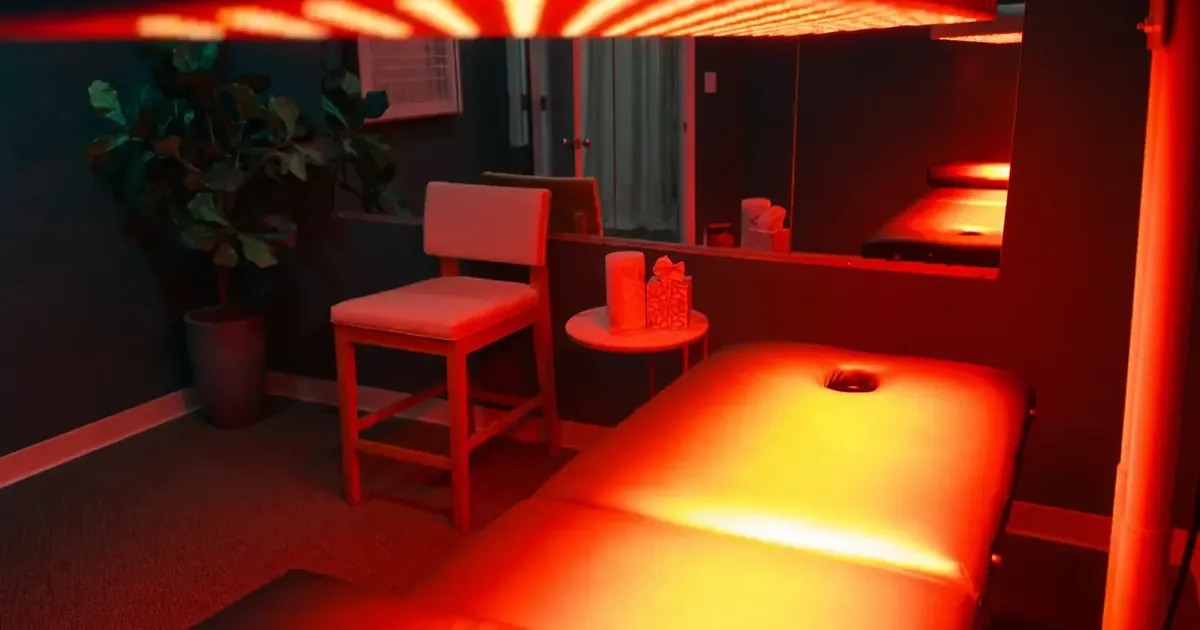
Red light therapy has gone from a niche clinical tool to something sold at gyms, spas, and online. That popularity has created a lot of noise. This guide covers what the light actually does inside your body, what the research supports, where the evidence is thin, and how a pain-focused clinic decides when it's worth using.
What is red light therapy, exactly?
Red light therapy is the application of specific wavelengths of visible red and invisible near-infrared (NIR) light to the skin and underlying tissue. In research literature it's usually called photobiomodulation (PBM) or, in older studies, low-level laser therapy (LLLT). Modern clinical devices use either lasers or arrays of light-emitting diodes (LEDs).
Three things separate it from other light-based treatments:
- No ultraviolet light. Unlike tanning beds or UV phototherapy, red light therapy doesn't use the wavelengths linked to skin damage, according to Cleveland Clinic.
- No heat-based effect. The goal is a photochemical reaction in cells, not warming tissue the way a heating pad or infrared sauna does.
- Low power, specific dose. The light is intentionally gentle. As you'll see below, more is not better.
How does red light therapy work in the body?
The leading explanation centers on your mitochondria — the structures inside cells that produce energy.
A mitochondrial enzyme called cytochrome c oxidase absorbs red and near-infrared light. When it does, researchers believe it releases nitric oxide that had been inhibiting it, which lets the cell's energy chain run more efficiently. The result is more ATP (cellular energy), a brief, signaling-level change in reactive oxygen species, and downstream shifts in genes tied to repair and inflammation. This mechanism is laid out in detail by de Freitas and Hamblin in a 2016 review of proposed photobiomodulation mechanisms.
Hamblin's 2017 review of PBM's anti-inflammatory effects describes the practical outcome: lower levels of inflammatory markers and a shift in immune cells toward a repair-oriented state. That's the biological basis for using red light on painful, irritated soft tissue.
In plain terms: red light doesn't "heal" tissue directly. It gives stressed cells more energy and a calmer chemical environment to do their own repair work.
What's the difference between red light and near-infrared light?
The main difference is how deep the light travels.
| Red light | Near-infrared (NIR) light | |
|---|---|---|
| Typical wavelength | ~620–700 nm (often 630–660 nm) | ~780–1,100 nm (often 810–850 nm) |
| Visible? | Yes — glows red | No — invisible to the eye |
| Penetration | Shallower — skin and superficial tissue | Deeper — muscle, tendon, around joints |
| Common uses | Skin, superficial wounds, surface tissue | Muscle pain, joint pain, recovery |
For musculoskeletal pain — the kind we see most at Body In Gear — near-infrared wavelengths usually matter more, because the problem tissue sits beneath the skin. Many clinical panels combine both.
What does the research say red light therapy helps?
The evidence is strongest for specific musculoskeletal pain conditions:
- Neck pain. A 2009 meta-analysis in The Lancet pooled 16 randomized controlled trials with 820 patients. In chronic neck pain, laser therapy reduced pain by about 20 points on a 100-point scale, with benefits lasting up to 22 weeks after treatment ended.
- Knee osteoarthritis. A 2019 BMJ Open meta-analysis of 22 placebo-controlled trials (1,063 participants) found that when recommended doses were used, pain dropped significantly more than placebo — and the effect held 2–12 weeks after treatment.
- Chronic low back pain. The American College of Physicians' 2017 clinical guideline lists low-level laser therapy among the non-drug treatments clinicians should try first for chronic low back pain (based on low-quality evidence).
- Muscle recovery. A 2015 meta-analysis by Leal-Junior and colleagues found that phototherapy applied before exercise improved performance and reduced markers of muscle damage.
Where the evidence is weaker: many popular claims — fat loss, "detox," hair regrowth for every cause, broad anti-aging — rest on small studies or manufacturer marketing. Even in the stronger areas, results depend heavily on dose and wavelength, and red light works best as part of a broader plan, not by itself.
Is red light therapy safe?
For most adults, yes, when it's used correctly. Red light therapy has a low side-effect profile in clinical studies, and it doesn't use UV light. The most common precautions:
- Protect your eyes. Bright LED arrays and lasers can strain or injure the eyes. Use goggles.
- Check your medications. Some drugs increase light sensitivity.
- Tell your provider about cancer history, pregnancy, or thyroid conditions before light is applied over those areas.
- Don't overdo it. More time under the light doesn't mean more benefit, and can blunt the effect.
Why does the "dose" of red light matter so much?
Red light follows what researchers call a biphasic dose response: too little does nothing, the right amount helps, and too much can cancel the benefit. Huang and colleagues (2009) documented this pattern across cell, animal, and human studies.
This is the single biggest reason results vary so much from person to person and device to device. The knee osteoarthritis meta-analysis above is a good example: the effect showed up clearly in trials that used recommended doses, and much less in trials that didn't.
Dose depends on wavelength, power, distance from the skin, treatment time, and how many sessions you do. That's why "just stand in front of it for 20 minutes" isn't a treatment plan.
Is clinic red light therapy different from at-home devices?
Often, yes. Consumer devices vary widely in power output and wavelength accuracy, and most don't publish verified dosing. Clinical devices are typically more powerful and more consistent, and a clinician decides where to apply light and how much.
The bigger difference is context. At home, red light is a standalone gadget. In a clinic, it's one tool inside a plan built around why you hurt.
How does Body In Gear use red light therapy?
We start with diagnosis, not devices. Our intake process identifies whether your pain comes from soft tissue dysfunction — restricted fascia, adhesions between muscles, nerve compression — or from something else that needs a different path.
When red light fits, we use it alongside the hands-on soft tissue work our clinic is built around: medical massage, myofascial release, and manual adhesion technique. Red light helps calm irritated tissue; manual therapy addresses the mechanical restriction causing the problem. We cover that pairing in depth in red light therapy + soft tissue therapy.
Next in this series: Red light therapy for chronic joint and back pain · How many red light therapy sessions do you need? · Back to the Red Light Therapy hub
Frequently asked questions
Does red light therapy actually work? For certain conditions, yes. Meta-analyses show meaningful pain reduction for chronic neck pain and knee osteoarthritis when correct doses are used. Evidence for many cosmetic and wellness claims is much weaker.
Is red light therapy the same as an infrared sauna? No. Infrared saunas work mainly through heat. Red light therapy works through a photochemical effect on cells at low power, without significant heating.
How long is a red light therapy session? Clinical sessions are commonly in the range of a few minutes to about 20 minutes per area, depending on the device's power and the target tissue. More time is not automatically better.
Does red light therapy hurt? No. Most people feel nothing or mild warmth.
Can I use red light therapy instead of physical therapy? It's best used as part of a plan, not a replacement. Red light can reduce pain and inflammation, but it doesn't fix the mechanical or soft tissue problem that caused the pain.
Ready to find out what's actually causing your pain? Book an evaluation at Body In Gear in Palatine — we'll tell you whether red light therapy fits your plan, or whether something else should come first.
Medical disclaimer: This article is for educational purposes and is not a substitute for medical advice, diagnosis, or treatment. Talk with your physician or a licensed provider before starting any new treatment, especially if you are pregnant, have a cancer history, or take photosensitizing medications.
About the author
Zach Mayfield, LMT is the owner of Body In Gear in Palatine, IL, a clinic focused on root-cause, non-pharmaceutical pain resolution through myofascial release, manual adhesion technique, and medical massage.
Clinically reviewed by Darshan Patel, PT, DPT, a Doctor of Physical Therapy at Body In Gear.
References
- Cleveland Clinic. Red Light Therapy. https://my.clevelandclinic.org/health/articles/22114-red-light-therapy
- de Freitas LF, Hamblin MR. Proposed mechanisms of photobiomodulation or low-level light therapy. IEEE J Sel Top Quantum Electron. 2016;22(3):7000417. https://pmc.ncbi.nlm.nih.gov/articles/PMC5215870/
- Hamblin MR. Mechanisms and applications of the anti-inflammatory effects of photobiomodulation. AIMS Biophys. 2017;4(3):337–361. https://pmc.ncbi.nlm.nih.gov/articles/PMC5523874/
- Chow RT, Johnson MI, Lopes-Martins RA, Bjordal JM. Efficacy of low-level laser therapy in the management of neck pain: a systematic review and meta-analysis. Lancet. 2009;374(9705):1897–1908. https://pubmed.ncbi.nlm.nih.gov/19913903/
- Stausholm MB, et al. Efficacy of low-level laser therapy on pain and disability in knee osteoarthritis: systematic review and meta-analysis. BMJ Open. 2019;9(10):e031142. https://pmc.ncbi.nlm.nih.gov/articles/PMC6830679/
- Qaseem A, et al. Noninvasive treatments for acute, subacute, and chronic low back pain: a clinical practice guideline from the American College of Physicians. Ann Intern Med. 2017;166(7):514–530. https://www.acpjournals.org/doi/10.7326/M16-2367
- Leal-Junior ECP, et al. Effect of phototherapy on exercise performance and markers of exercise recovery: a systematic review with meta-analysis. Lasers Med Sci. 2015;30(2):925–939. https://link.springer.com/article/10.1007/s10103-014-1611-7
- Huang YY, Chen AC, Carroll JD, Hamblin MR. Biphasic dose response in low level light therapy. Dose Response. 2009;7(4):358–383. https://pmc.ncbi.nlm.nih.gov/articles/PMC2790317/