Red light therapy can support muscle recovery. Research shows that red and near-infrared light, especially when applied before exercise, can improve performance and reduce markers of muscle damage. Its effect on next-day soreness is less consistent. It works best as one part of a recovery plan that also addresses tight, restricted tissue.
Whether you run the trails around the northwest suburbs, lift, play a weekend league, or train for a race, recovery decides how often you can train hard without breaking down. Red light therapy is increasingly part of that conversation. Here's what the sports science supports — and what's still hype.
Does red light therapy help muscle recovery?
The evidence is encouraging, with some important nuance.
- A 2015 systematic review and meta-analysis in Lasers in Medical Science found that phototherapy (laser or LED) applied before exercise improved exercise performance and lowered markers of exercise-induced muscle damage.
- A 2016 review by Ferraresi, Huang, and Hamblin summarized human studies showing light can increase muscle performance, delay fatigue, and reduce muscle damage.
- A meta-analysis focused on creatine kinase — an enzyme that leaks into the blood when muscle is damaged — found phototherapy had a large beneficial effect after localized exercise (a standardized mean difference of 0.89).
Where the evidence is weaker: a 2016 meta-analysis on delayed onset muscle soreness found that light may not substantially reduce the feeling of soreness after exercise, even where other recovery markers improved. In other words, red light may help your muscles recover more than it helps you feel less sore the next day.
How does red light therapy help muscles?
Working muscle is one of the most energy-hungry tissues in your body. Red and near-infrared light are absorbed by mitochondria, which can boost ATP production — the energy cells use to contract and repair.
Researchers believe this leads to:
- More energy available during and after hard efforts
- Less oxidative stress and muscle damage from intense training
- A shift toward repair in local inflammation
Because muscle sits beneath skin and fat, near-infrared wavelengths (roughly 780–1,100 nm) are typically more relevant for muscle than visible red light alone.
Should you use red light therapy before or after a workout?
Most of the research tested light before exercise. A 2020 study in Frontiers in Physiology notes that 92% of studies in the Leal-Junior meta-analysis applied light pre-exercise, with relatively few testing post-exercise treatment.
A practical way to think about timing:
- Before training or competition: best supported for performance and limiting muscle damage
- After training: less studied, but commonly used to support recovery from a hard session or block
- On rest days: reasonable when you're working through overuse irritation in a specific area
The more important variable is dose. Red light follows a biphasic dose response — too little does nothing, too much can blunt the benefit. Longer isn't better.
Who benefits most from red light therapy for recovery?
- Endurance athletes stacking high-volume weeks — runners, cyclists, triathletes
- Strength athletes recovering from heavy eccentric work (the lowering phase that causes the most damage)
- Weekend warriors who get beat up after one big game or hike
- Masters athletes whose recovery has slowed with age
- Active people managing overuse irritation — sore tendons, recurring calf or hamstring tightness
Can red light therapy prevent injury?
No therapy prevents injury on its own. But better recovery between sessions lowers the chance you train hard on tissue that hasn't bounced back — a common setup for strains and overuse injuries.
That's where our pre-hab focus comes in. At Body In Gear, we specialize in catching problems before they turn into injuries: the hamstring that's always tight, the shoulder that's "fine but not right," the calf that cramps late in long runs. Those are usually soft tissue warning signs.
Why light alone isn't a complete recovery plan
Red light can support muscle energy and repair. It can't release a band of restricted fascia or an adhesion between two muscles that's altering how you move. Those mechanical problems often drive the nagging, recurring tightness athletes deal with.
A strong recovery plan combines:
- Training load management — the foundation
- Sleep and nutrition — non-negotiable
- Hands-on soft tissue work — myofascial release, medical massage, and manual adhesion technique to restore how tissue moves
- Red light therapy — to support cellular recovery and calm irritated tissue
We explain how light and manual therapy work together in red light therapy + soft tissue therapy.
What does red light therapy for athletes look like at a clinic?
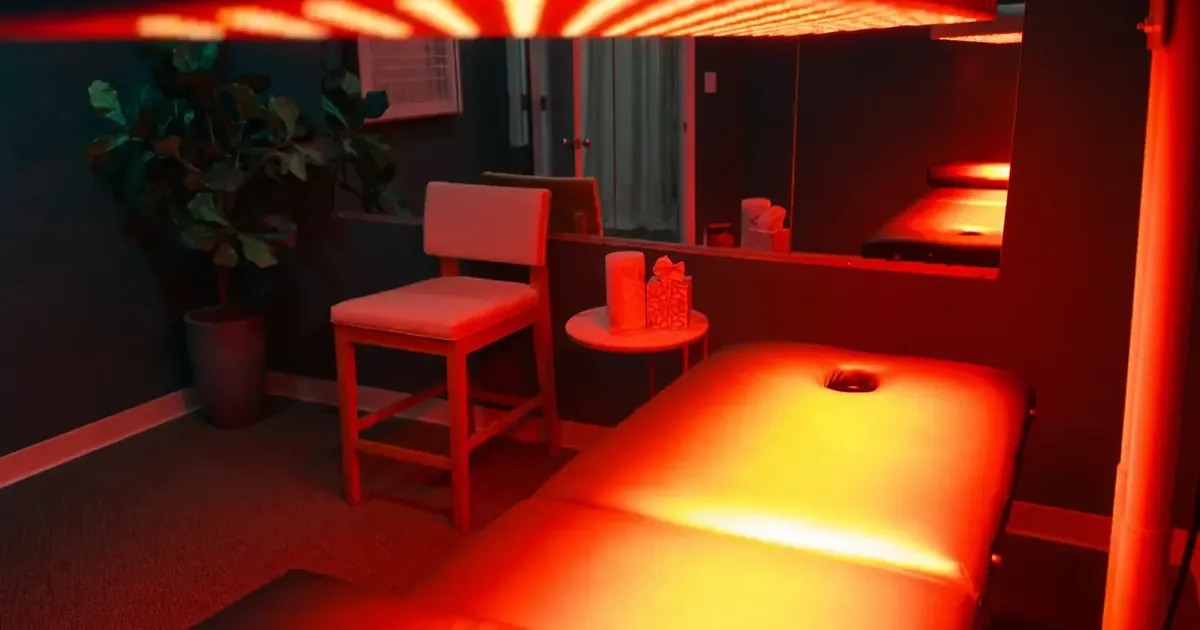
Treatment starts with understanding your sport, training load, and problem areas. Light is applied to the specific muscle groups you're loading or the area that keeps flaring, often combined with hands-on work on the same tissue. During heavy training blocks or before key events, sessions may be grouped more closely.
Related: What red light therapy is · How many red light therapy sessions do you need? · Red Light Therapy hub
Frequently asked questions
Does red light therapy reduce muscle soreness? It can reduce markers of muscle damage and may improve performance, but research on the soreness you feel the next day is mixed.
Is red light therapy good for runners? It can support recovery during high-mileage training, especially for the calves, hamstrings, and quads. It works best alongside load management and soft tissue care.
How long before a workout should I use red light? Most studies applied light shortly before exercise. Follow your provider's guidance for your device and dose.
Can red light therapy build muscle? Some studies suggest light combined with training may enhance gains, but it doesn't build muscle on its own. Training does that.
Is red light therapy allowed in competitive sports? Red light therapy is a physical treatment rather than a substance. Check your sport's governing body if you compete at a level with specific rules on recovery treatments.
Training hard and tired of the same tight spots? Book a session at Body In Gear in Palatine and get a recovery plan that treats the tissue, not just the soreness.
Medical disclaimer: This article is for educational purposes only and is not medical advice. Seek medical evaluation for acute injuries, swelling, sharp pain, or pain that doesn't improve with rest.
About the author
Zach Mayfield, LMT is the owner of Body In Gear in Palatine, IL, a clinic focused on root-cause, non-pharmaceutical pain resolution through myofascial release, manual adhesion technique, and medical massage.
Clinically reviewed by Darshan Patel, PT, DPT, a Doctor of Physical Therapy at Body In Gear.
References
- Leal-Junior ECP, et al. Effect of phototherapy (low-level laser therapy and light-emitting diode therapy) on exercise performance and markers of exercise recovery: a systematic review with meta-analysis. Lasers Med Sci. 2015;30(2):925–939. https://link.springer.com/article/10.1007/s10103-014-1611-7
- Ferraresi C, Huang YY, Hamblin MR. Photobiomodulation in human muscle tissue: an advantage in sports performance? J Biophotonics. 2016;9(11-12):1273–1299. https://pmc.ncbi.nlm.nih.gov/articles/PMC5167494/
- Machado AF, et al. Phototherapy on management of creatine kinase activity in general versus localized exercise: a systematic review and meta-analysis. https://repositorio.unesp.br/handle/11449/196866
- Nampo FK, et al. Effect of low-level phototherapy on delayed onset muscle soreness: a systematic review and meta-analysis. Lasers Med Sci. 2016;31(1):165–177. https://search.pedro.org.au/search-results/record-detail/44266
- The effects of whole-body photobiomodulation light-bed therapy on creatine kinase and salivary interleukin-6 in a sample of trained males: a randomized, crossover study. Front Physiol. 2020. https://pmc.ncbi.nlm.nih.gov/articles/PMC7739664
- Huang YY, Chen AC, Carroll JD, Hamblin MR. Biphasic dose response in low level light therapy. Dose Response. 2009;7(4):358–383. https://pmc.ncbi.nlm.nih.gov/articles/PMC2790317/