Quick answer: For chronic pain, research supports starting with 60-minute sessions two to three times per week for about four weeks, then tapering to weekly and eventually monthly maintenance as pain improves. Shorter or less frequent sessions often aren't enough to change chronic pain. Your exact schedule should depend on your condition and how your body responds.
How often should you get medical massage for chronic pain?
More often at the start, less often later. The strongest dosing evidence comes from a randomized trial of 228 adults with chronic neck pain published in Annals of Family Medicine (Sherman et al., 2014). Participants received four weeks of massage on one of five schedules:
| Schedule (4 weeks) | Result vs. wait-list control |
|---|---|
| 30 min, 2x/week | Not significantly better |
| 30 min, 3x/week | Not significantly better |
| 60 min, 1x/week | Not statistically significant |
| 60 min, 2x/week | 3.41x more likely to meaningfully improve neck function |
| 60 min, 3x/week | 4.98x more likely to meaningfully improve neck function |
The authors' conclusion was direct: multiple 60-minute sessions per week worked better than fewer or shorter sessions. That's why "once a month" — the schedule most people default to — usually isn't enough to resolve a chronic problem, even though it's a great maintenance schedule later on.
What does a typical medical massage schedule look like?
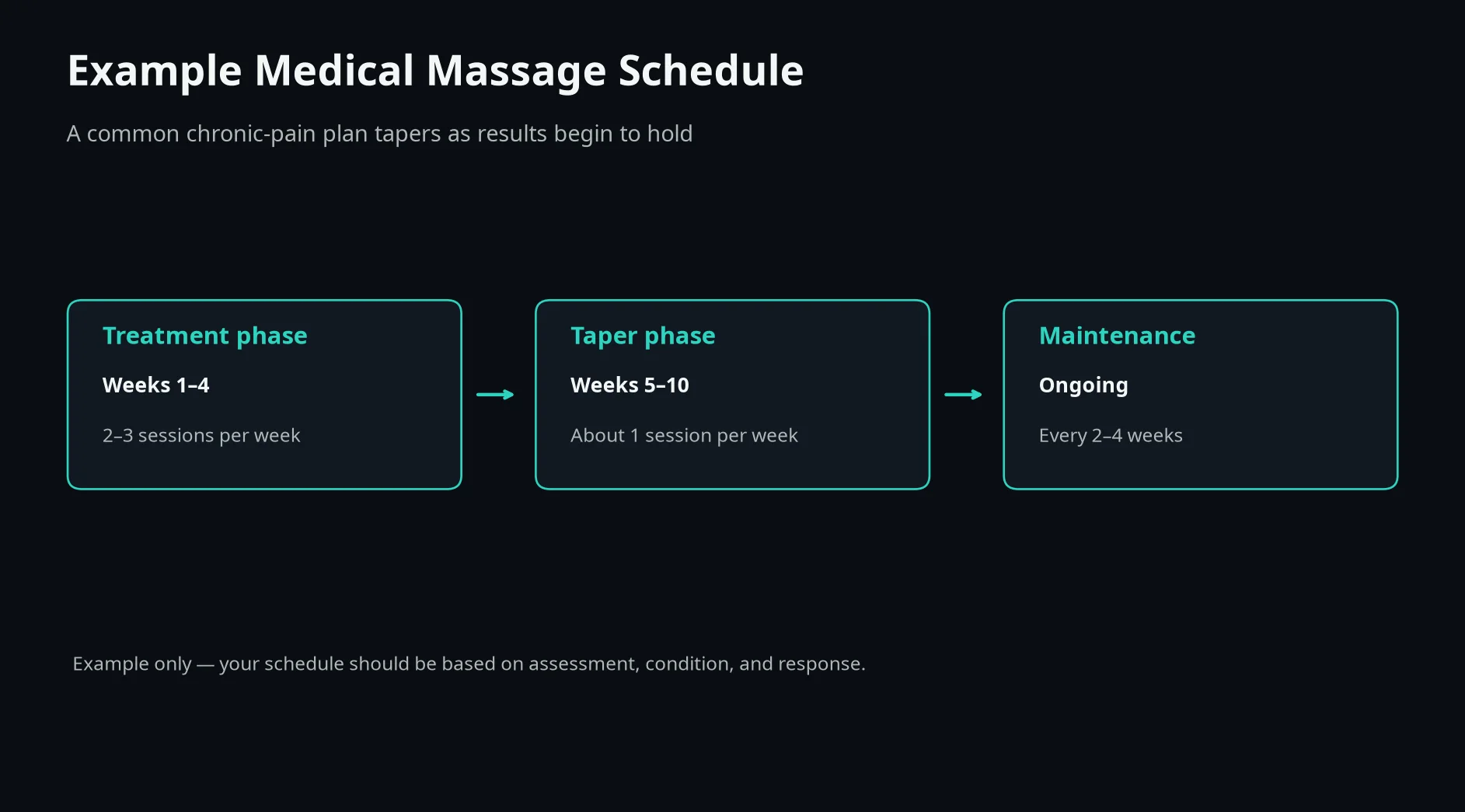
A common structure for chronic pain has three phases. Your schedule may look different, but this is the general shape:
- Treatment phase (roughly weeks 1–4): 2–3 sessions per week. The goal is enough frequency that each session builds on the last before tissue and nervous system tension return.
- Taper phase (roughly weeks 5–10): about 1 session per week, as pain decreases and results hold longer between visits.
- Maintenance: every 2–4 weeks, or as needed, to keep problem areas from building back up.
The taper phase matters. In a follow-up to the neck pain trial, researchers found that patients who started with 60-minute sessions benefited from additional "booster" sessions after the initial four weeks, and recommended building them into care (Cook et al., 2015, The Spine Journal).
Does session length matter as much as frequency?
Yes — possibly more. In the Sherman trial, 30-minute sessions didn't beat the wait list even at three times per week, while 60-minute sessions did at two or three times per week. Doubling the frequency of a short session didn't make up for the lack of time.
That matches what we see clinically. Slow, deep work takes time: the nervous system has to settle before fascia will release, and adhesions have to be located by hand before they can be treated. At Body In Gear, every session is a full 60 minutes of soft tissue therapy for exactly that reason — it's also why we deliver 1,400% more soft tissue therapy than a typical 4-minute add-on model.
How long until you feel results from medical massage?
Many people notice some change within the first few sessions, but lasting improvement usually takes several weeks of consistent care. In the Sherman trial, meaningful improvements were measured after four weeks of treatment.
A large trial of 401 adults with chronic low back pain published in Annals of Internal Medicine used 10 weekly massage sessions and found meaningful improvement in function and symptoms at 10 weeks, with benefits fading over the following year for many participants (Cherkin et al., 2011). That's a strong argument for two things: a real initial dose, and some form of ongoing maintenance.
Chronic pain is a long-term problem for a lot of people. The CDC reports that 24.3% of U.S. adults had chronic pain in 2023 (CDC NCHS Data Brief No. 518), and it rarely resolves in a single appointment.

Can you get medical massage too often?
Yes, if your tissue doesn't get time to recover. Some tenderness for 24–48 hours after a focused session is normal. A few guidelines:
- Space sessions at least a day apart during the treatment phase
- Tell your therapist if soreness lasts more than two days — intensity or frequency should be adjusted
- Pause and check with a doctor if you notice new numbness, weakness, swelling, or sharp pain
The NIH's National Center for Complementary and Integrative Health notes that massage is generally safe when delivered by a trained professional, but some people — including those with blood clots, fractures, or certain conditions — may need precautions (NCCIH).
What should you do between medical massage sessions?
What you do between sessions can help results last longer:
- Move gently every day — walking and light mobility help tissue stay loose
- Use self-care tools on the areas your therapist identified, like a massage ball for upper back tension, rather than guessing
- Stay hydrated and notice what activities flare your pain
- Keep your schedule consistent during the treatment phase — skipping sessions early can reset progress
Massage guns and foam rollers can help here, as long as they're used as maintenance rather than a replacement for treatment. Here's why a massage gun alone usually isn't enough.
Frequently asked questions
How often should you get a massage for chronic back pain?
A common starting point is two to three 60-minute sessions per week for about four weeks, then tapering to weekly and eventually every two to four weeks for maintenance. Research on chronic neck and low back pain supports multiple longer sessions early in care.
Is once a month enough massage for chronic pain?
Monthly massage is a good maintenance schedule, but research suggests it's usually not enough to resolve chronic pain on its own. In a trial on chronic neck pain, only 60-minute sessions two or three times per week produced statistically significant improvement over a control group.
How many medical massage sessions will I need?
It depends on how long you've had pain, what's causing it, and how your body responds. Many chronic pain patients need several weeks of consistent sessions before tapering. Your therapist should reassess progress regularly.
Is it bad to get a massage every day?
Daily deep or focused massage doesn't give tissue time to recover and can increase soreness. During an active treatment phase, spacing sessions at least a day apart is generally a better approach.
Why are 60-minute sessions better than 30-minute sessions?
In a randomized trial on chronic neck pain, 30-minute sessions were not significantly better than no treatment, even at three times per week, while 60-minute sessions two or three times per week were. Slow, targeted soft tissue work needs enough time to calm the nervous system and treat the source of pain.
Related reading
- What Is Medical Massage? How It's Different From a Spa or Relaxation Massage (pillar)
- Medical Massage vs. Deep Tissue Massage: Which Do You Actually Need?
- Medical Massage vs. Massage Envy and Franchise Massage: What's the Real Difference?
- Soft Tissue Therapy vs. a Massage Gun: Why 5 Minutes Isn't Enough
Not sure what schedule is right for your pain? Book a medical massage assessment at Body In Gear in Palatine →
About the author: Zach Mayfield, LMT, is the owner and lead soft tissue specialist at Body In Gear in Palatine, IL. His work focuses on finding the root cause of chronic pain through medical massage, myofascial release, and Manual Adhesion Technique — without pills, injections, or surgery.
This article is for educational purposes and isn't a substitute for medical advice. If you have severe, sudden, or worsening pain, numbness, or weakness, see a medical provider.