Quick answer: A massage gun can briefly loosen tight muscles and improve flexibility, but it can't locate or release the adhesions and fascial restrictions behind most chronic pain. Research on massage guns shows short-term effects, while trials of hands-on therapy show that meaningful pain relief depends on longer, repeated sessions — not a few minutes tacked onto a visit.
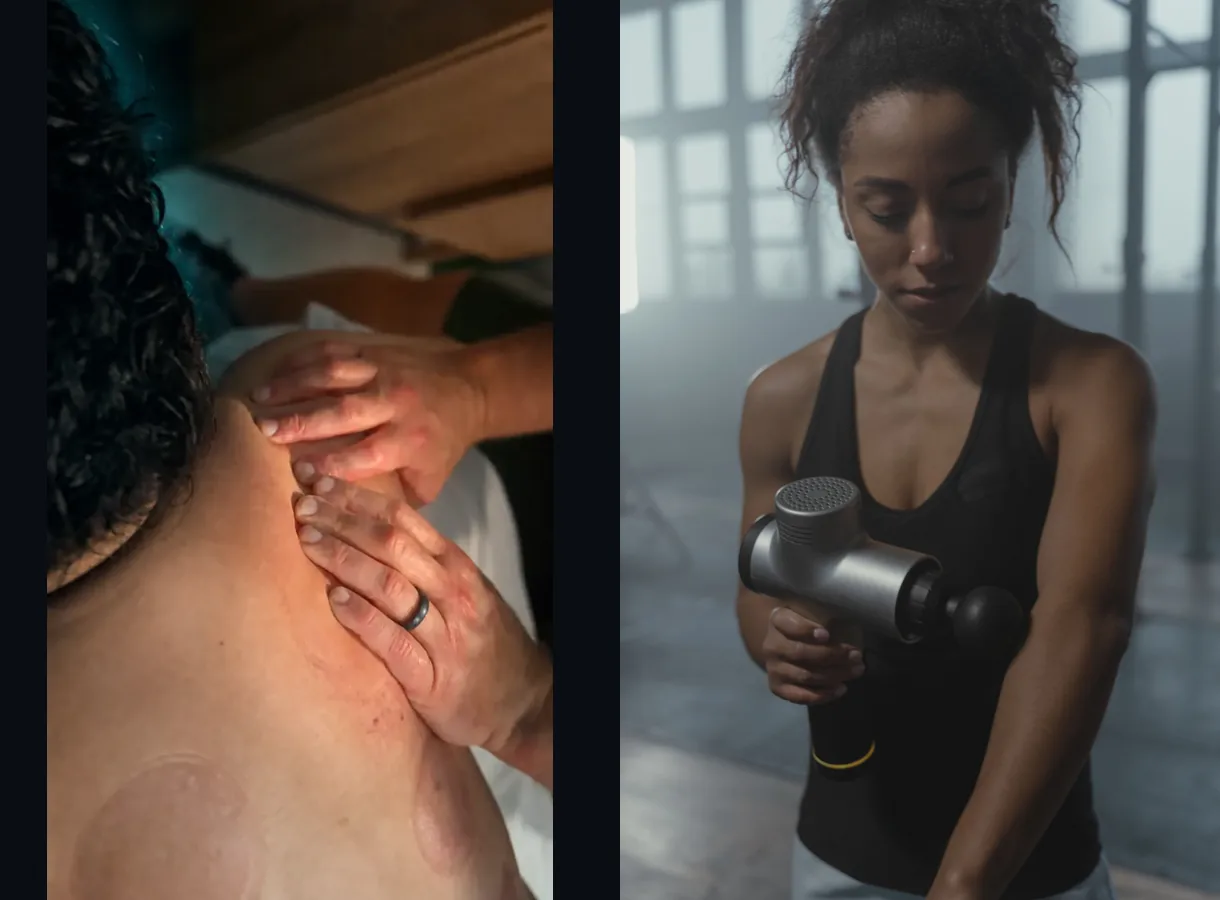
Does a massage gun actually help with pain?
Yes, in the short term. A 2023 systematic review in the International Journal of Sports Physical Therapy pooled 13 studies with 255 participants and found that a single percussive session can acutely improve muscle strength, explosive strength, and flexibility, while multiple treatments were linked to reduced musculoskeletal pain (Sams et al., 2023, PubMed).
Notice what that review measured: short-term performance and flexibility, mostly in healthy or athletic adults. One frequently cited protocol applied the gun to the calves for 5 minutes and measured ankle range of motion immediately afterward. That's useful information for a warm-up. It's not evidence that 5 minutes fixes pain you've had for months or years.
And chronic pain is a big problem. The CDC reports that 24.3% of U.S. adults had chronic pain in 2023, and 8.5% had pain that frequently limited daily life or work (CDC NCHS Data Brief No. 518). Most of those people don't need a better warm-up. They need someone to find where the pain is coming from.
Can a massage gun break up adhesions or fascia?
No — because it can't feel them. Adhesions form where neighboring muscles with overlapping jobs "glue" together. A classic example: the trapezius and rhomboids both pull the shoulder blade back, so they commonly bind where they meet, restricting movement and sometimes compressing nearby nerves.
Finding that spot takes palpation — a trained hand feeling for the change in tissue texture, then working slowly enough for the nervous system to let go. That's the foundation of our work at Body In Gear:
- Medical massage first, to calm the nervous system and open access to deeper tissue
- Myofascial release, using slow strokes to stretch and release restricted fascia
- Manual Adhesion Technique (MAT), to locate and release adhesions between muscles
A massage gun delivers fast, repetitive percussion to whatever it's pointed at. It doesn't know if it's on the adhesion, two inches away from it, or on a muscle that's tight because it's compensating for a problem somewhere else. Cleveland Clinic describes myofascial pain as often coming from trigger points that can refer pain to other areas (Cleveland Clinic) — which is exactly why "rub where it hurts" so often misses.
Why do some clinics only use a massage gun for a few minutes?
Mostly because of how appointments are scheduled and billed, not because a few minutes is clinically ideal. In many high-volume physical therapy and chiropractic models, a clinician moves between several patients in the same hour, and hands-on soft tissue work becomes a brief add-on — often a massage gun or quick trigger point work lasting roughly 4–5 minutes.
Billing rules reinforce that pattern. Under Medicare's timed-code rule, a 15-minute treatment unit can be billed once at least 8 minutes of that service is delivered (CMS Medicare Claims Processing Manual, Ch. 5, §20.2). That doesn't mean any clinic is doing something wrong. It means the system doesn't reward long, focused hands-on sessions.
That isn't true of every clinic, and plenty of great clinicians work in those settings. But if your "soft tissue work" has consisted of a few minutes with a massage gun before exercises, you likely haven't had a real dose of it yet.
How much hands-on time does chronic pain actually need?
More than most people get. The best dosing evidence comes from a randomized trial of 228 adults with chronic neck pain published in Annals of Family Medicine. Participants received massage in 30- or 60-minute sessions, one to three times per week, for four weeks (Sherman et al., 2014, PubMed).
The results were clear:
- 30-minute sessions were not significantly better than a wait list — at any frequency
- 60-minute sessions 2–3 times per week significantly increased the likelihood of meaningful improvement
- Three 60-minute sessions a week made patients 4.98 times more likely to see a meaningful improvement in neck function than the control group
If 30 minutes of skilled, hands-on massage wasn't enough to beat a wait list, 4–5 minutes with a massage gun is very unlikely to change chronic pain on its own.

What does "1,400% more soft tissue therapy" actually mean?
It's straightforward math based on time spent on soft tissue work over a typical course of care. Using a common add-on of about 4 minutes per visit versus Body In Gear's full 60-minute sessions, across 16 visits:
| Typical add-on model | Body In Gear | |
|---|---|---|
| Soft tissue time per visit | ~4 minutes | 60 minutes |
| Visits | 16 | 16 |
| Total soft tissue time | 64 minutes | 960 minutes |
That's 896 more minutes of soft tissue work. 896 ÷ 64 = 14, or 1,400% more soft tissue therapy. Read the full breakdown in our pillar guide.
Is a massage gun ever worth using?
Absolutely — as a tool, not a treatment plan. We're fans of massage guns for:
- Warming up before a workout or run
- Maintenance between sessions, on areas your therapist has already identified
- General soreness after exercise
Use common sense: keep it off bony areas, the front and sides of the neck, and anywhere with numbness, swelling, or unexplained pain. Talk to your doctor before using one if you have a blood clotting condition, take blood thinners, or have nerve damage.
The best way to think about it: the massage gun keeps the work going. Hands-on soft tissue therapy does the work.
Massage gun vs. soft tissue therapy: side-by-side
| Massage gun | Hands-on soft tissue therapy | |
|---|---|---|
| Finds the source of pain | No | Yes, through palpation and assessment |
| Treats adhesions between muscles | No | Yes (MAT) |
| Releases restricted fascia | Surface-level at best | Yes (myofascial release) |
| Adjusts to how your nervous system responds | No | Yes — slow strokes, real-time feedback |
| Best for | Warm-ups, maintenance, soreness | Chronic and recurring pain |
Frequently asked questions
Can a massage gun replace physical therapy or soft tissue therapy?
No. Research shows massage guns produce short-term changes in flexibility and soreness, but they can't assess where your pain comes from or treat adhesions and fascial restrictions. They work best as a between-session tool.
How long should you use a massage gun on one muscle?
Studies commonly use about 30 seconds to 2 minutes per area, and some protocols run up to 5 minutes on a large muscle group like the calves. Longer isn't better, and you should stop if it causes pain or numbness.
Why does my pain come back after using a massage gun?
Because the gun temporarily relaxes the tissue without changing what's driving the problem — such as an adhesion between two muscles or a restricted area of fascia elsewhere in the chain. When the short-term effect wears off, the pain returns.
How long are soft tissue therapy sessions at Body In Gear?
Full 60-minute sessions dedicated to soft tissue therapy, including medical massage, myofascial release, and Manual Adhesion Technique, targeted to the specific source of your pain.
Is soft tissue therapy painful?
It shouldn't be sharp or unbearable. Our approach uses slow, deliberate strokes specifically to calm the nervous system so we can reach deeper tissue without forcing it. Some tenderness afterward is normal.
Related reading
- Why Body In Gear Gives You 1,400% More Soft Tissue Therapy Than Standard PT or Chiropractic Care (pillar)
- Soft Tissue Therapy vs. Chiropractic Care: What's the Real Difference?
- Myofascial Release vs. Deep Tissue Massage: Key Differences
- Why Most Physical Therapy Sessions Don't Include Enough Soft Tissue Work
- What Is Soft Tissue Dysfunction — and Why Is It Behind Most Chronic Pain?
- How Much Soft Tissue Therapy Do You Actually Need to See Results?
Tired of pain that comes back as soon as the massage gun wears off? Book a soft tissue therapy session at Body In Gear in Palatine →
About the author: Zach Mayfield, LMT, is the owner and lead soft tissue specialist at Body In Gear in Palatine, IL. His work focuses on finding the root cause of chronic pain through medical massage, myofascial release, and Manual Adhesion Technique — without pills, injections, or surgery.
This article is for educational purposes and isn't a substitute for medical advice. If you have severe, sudden, or worsening pain, numbness, or weakness, see a medical provider.