Soft tissue therapy targets muscles, fascia, and tendons directly through hands-on manual work; chiropractic care primarily uses spinal manipulation to adjust joint alignment. Both are legitimate, licensed approaches to pain relief — the right one depends on whether your pain is coming from soft tissue restriction or joint/spinal alignment, which is exactly what a proper intake assessment is meant to determine.
What is chiropractic care, really?
According to the National Center for Complementary and Integrative Health (NCCIH), chiropractic is a licensed health care profession built on the idea that the body has a strong ability to heal itself, with treatment typically centered on manual therapy — most often spinal manipulation, sometimes paired with exercise or nutritional counseling. Chiropractors interview patients, take a health history, examine and test, then build a treatment plan, similar to how a physical therapist approaches care.
This isn't a fringe or unproven approach — it's a licensed, regulated profession, and NCCIH notes that about 11% of U.S. adults used chiropractic care in 2022, most commonly for pain management. The scope of what a chiropractor can treat does vary by state.
What is soft tissue therapy?
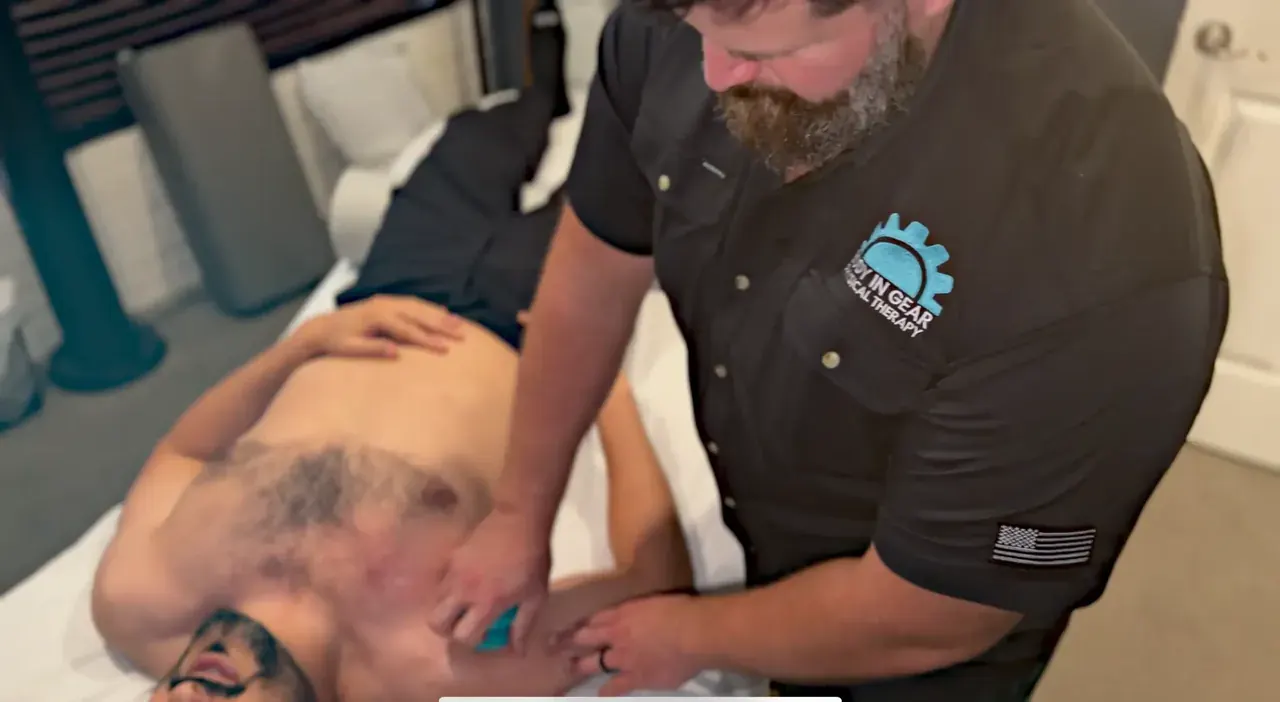
Soft tissue therapy is hands-on work performed directly on the muscles, fascia, tendons, and ligaments — the "soft" structures of the body, as opposed to the bones and joints chiropractic care primarily targets. At Body In Gear, this includes myofascial release, Manual Adhesion Technique (MAT), and medical massage, sequenced together across a full session.
The American Physical Therapy Association classifies soft tissue mobilization as a manual technique specifically used to improve tissue mobility and reduce pain — a different mechanism than spinal manipulation, targeting a different layer of the body entirely.
Key differences, side by side
| Chiropractic Care | Soft Tissue Therapy | |
|---|---|---|
| Primary target | Spinal joints and alignment | Muscles, fascia, tendons, ligaments |
| Primary technique | Spinal manipulation (a controlled thrust to a joint) | Manual pressure, stretching, and release techniques |
| Typical session focus | Adjustment, often brief | Sustained, hands-on work — a full 60-minute session at Body In Gear |
| Best suited for | Joint alignment issues, some acute and chronic low-back pain | Muscle/fascia restriction, adhesions, chronic soft-tissue-rooted pain |
Neither approach is universally "better" — they're built to address different underlying causes of pain, which is why a proper diagnosis matters more than picking a modality first.
Which one do I actually need?
If your pain is coming from a joint or spinal alignment issue, spinal manipulation may be the more direct approach. If your pain is coming from tight, restricted, or adhered soft tissue — which is frequently the case in longer-standing chronic pain — soft tissue therapy addresses that mechanism directly, and spinal manipulation alone may not resolve it.
This is exactly why Body In Gear starts every new patient with a real intake assessment rather than defaulting to one technique: the goal is identifying which structure is actually causing the pain before deciding how to treat it.
Worth knowing: research on spinal manipulation for low-back pain — including guidance cited by NCCIH from the American College of Physicians — describes it as one of several reasonable options for low-back pain, with the strength of supporting evidence described as low to moderate rather than definitive. That's not a knock on chiropractic care; it's the same kind of honest caveat that applies to most manual therapy research, soft tissue approaches included.
Can you do both chiropractic care and soft tissue therapy?
Yes — many patients use both, since they address different structures. Some patients see a chiropractor for spinal alignment and Body In Gear for the soft tissue component of their pain. This isn't an either/or decision for everyone; it depends on what your assessment actually finds.