Most physical therapy sessions dedicate only a small fraction of their time to hands-on soft tissue work — often just a few minutes — because typical clinic scheduling and billing structures aren't built around it. The rest of a session is usually spent on corrective exercise, equipment-based treatment, or brief manipulation, with soft tissue work treated as a warm-up rather than the main treatment.
Why don't most PT sessions include more soft tissue work?
It largely comes down to how outpatient clinics are scheduled and paid. Many insurance-driven physical therapy clinics are structured around seeing multiple patients per hour per therapist, with a physical therapist or physical therapist assistant supervising exercise equipment and rotating between patients rather than spending an entire session with one person. In that structure, hands-on manual work — including soft tissue therapy — tends to get compressed into a short slice of the visit, since the rest of the time is split across other patients on the floor at the same time.
This isn't a criticism of any individual therapist. It's a structural reality of how a lot of outpatient PT is scheduled and billed, and it shapes what's actually possible in a given visit regardless of how skilled the person treating you is.
How does clinic scheduling affect how much hands-on time you actually get?
It's a well-documented pattern within the physical therapy profession itself, not just a patient complaint. One licensed physical therapist writing publicly about the industry has described clinics that schedule five to six overlapping patients per therapist per hour, arguing plainly that a therapist managing that many patients simultaneously cannot give any one of them their best, most focused care. Other clinic-side accounts of overlap scheduling describe therapists splitting roughly 15 to 20 minutes of direct, one-on-one time with a patient during a shared hour, with the remainder spent on independent exercise or equipment.
The exact split varies by clinic and by how aggressively a given practice schedules its floor. But the underlying mechanism is consistent: when a therapist is responsible for more than one patient in the same hour, the total time available for hands-on work — including soft tissue therapy specifically — has to be divided across everyone on the floor.
What does the billing system actually require, minute for minute?
Medicare's own billing rules illustrate just how short a unit of "direct" treatment time can legally be. Under Medicare's guidelines for outpatient therapy, a therapist must provide at least 8 minutes of direct, one-on-one treatment time to bill a single unit of manual therapy or therapeutic exercise. That's the minimum threshold for billing — not a target for ideal patient care, but the floor the system is built around. A clinic operating near that minimum, especially one splitting attention across multiple patients per hour, has very little room left for a full soft tissue session on top of everything else on a treatment plan.

None of this means standard outpatient PT lacks value — corrective exercise and therapist-guided movement genuinely help a wide range of conditions, and it's part of what Body In Gear itself offers alongside soft tissue work. But if the actual source of pain lives in the muscles, fascia, tendons, or ligaments, a treatment structure built around brief, divided attention isn't set up to reach it.
What does this mean if your pain hasn't improved with standard PT?
If you've completed a course of physical therapy and the exercises "aren't doing much of anything" — a pattern Body In Gear hears often from new patients — it's worth considering whether the actual driver of your pain was ever directly and fully addressed. Soft tissue dysfunction that never gets more than a few minutes of hands-on attention per visit often doesn't resolve on its own, regardless of how consistently the corrective exercises were performed.
This isn't the right read for every case. Some pain genuinely is structural — a fracture, an acute disc herniation with red-flag symptoms, or a condition requiring imaging or immediate medical evaluation needs a different starting point entirely, not a soft-tissue-first approach. This is specifically about chronic or unexplained pain that hasn't responded to standard treatment.
What does a fully dedicated soft tissue session look like instead?
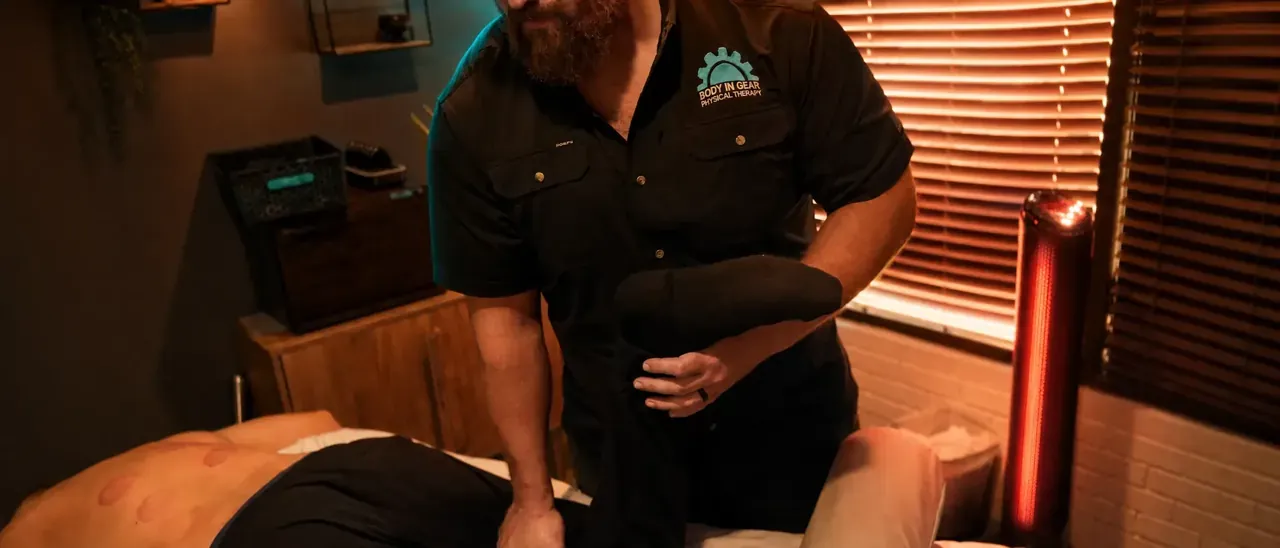
At Body In Gear, every soft tissue session is a full 60 minutes with one therapist, one patient, no rotation between multiple people in the same hour. That structure allows for medical massage to open the nervous system, myofascial release to lengthen and stretch restricted fascia, and Manual Adhesion Technique (MAT) to release specific adhesions — a sequence that simply isn't possible inside a divided, multi-patient hour. Based on a standard 16-session treatment plan, that works out to roughly 1,400% more dedicated soft tissue time than a typical clinic offering 4 to 5 minutes per visit — see the full math, worked out for the complete breakdown.